

Defining the Shift: Copilots vs. Autonomous Agents
To understand the trajectory of enterprise AI, we must clearly differentiate the tools we use today from the systems of tomorrow. Over the past year, copilots have emerged as invaluable digital assistants. Yet, their nature is fundamentally reactive and prompt-dependent. A copilot waits for your specific instructions, generates a response or piece of content, and then pauses until you provide the next command. They are highly capable, but they remain tethered to continuous human guidance.
Autonomous agents represent a profound departure from this model. Instead of waiting for step-by-step instructions, agents are goal-oriented and self-prompting. You provide a high-level objective, and the agent takes over. It assesses the overarching goal, breaks it down into logical steps, and executes those steps proactively without a human constantly holding the steering wheel.
The distinction boils down to three core shifts:
- Assistive vs. Goal-Oriented: Copilots help you complete a task; autonomous agents own the task from start to finish.
- Prompt-Dependent vs. Self-Prompting: Copilots rely on continuous user inputs; agents generate their own internal prompts to navigate roadblocks and advance the objective.
- Reactive vs. Proactive: Copilots wait for commands; agents actively interact with your software stack, anticipate needs, and take action.
This transition marks a monumental paradigm shift for the enterprise. We are moving beyond AI that merely generates text, images, or code in isolation. Instead, we are entering an era where AI can independently execute complex, multi-step workflows—such as analyzing a competitor's market position, cross-referencing internal databases, and directly updating project management software—all triggered by a single directive. It is the crucial leap from an assistant that requires constant direction to an autonomous digital worker that delivers completed business outcomes.

Building the Architectural Foundation
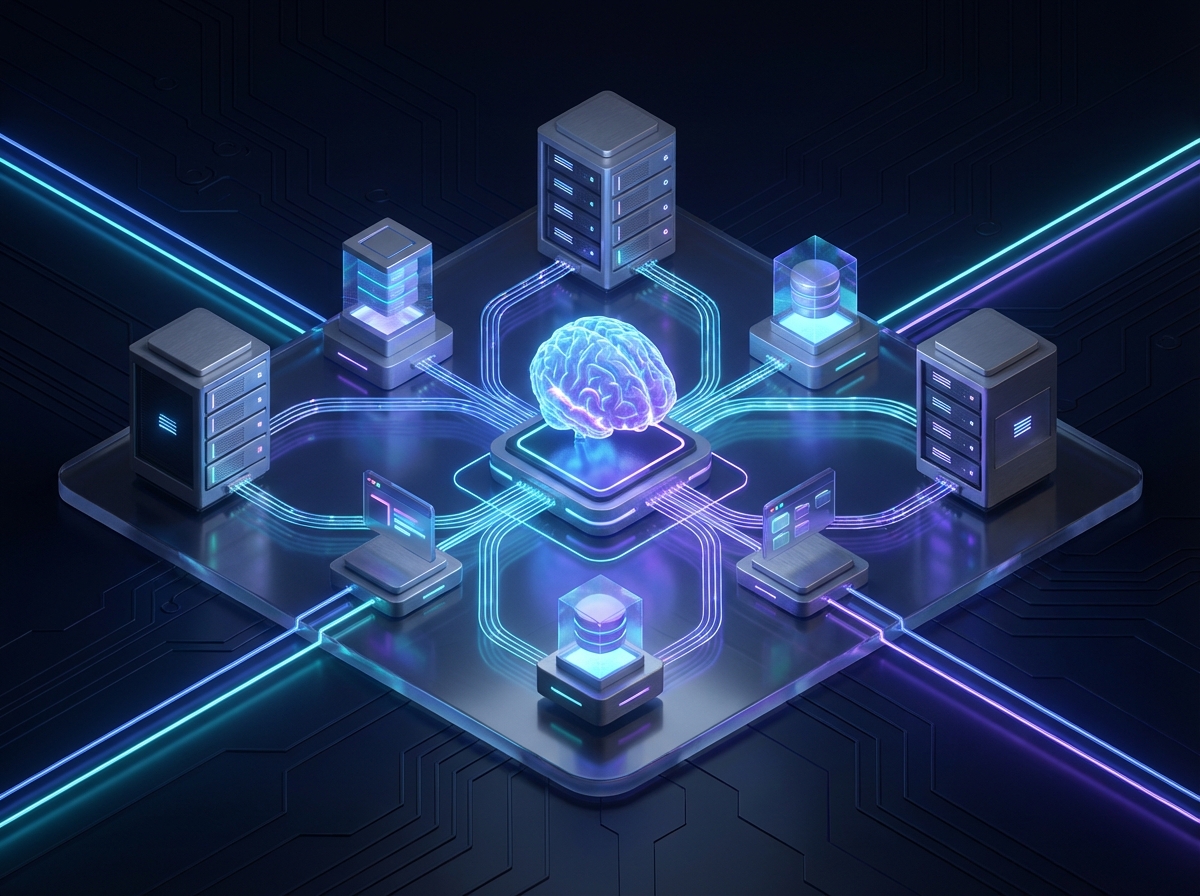
Transitioning from basic AI copilots to fully autonomous agents requires more than just a powerful large language model (LLM). Enterprises must construct a robust technical infrastructure designed for action, recall, and collaboration. To deploy agentic AI successfully at scale, several core architectural components must be in place.
Equipping agents to perceive and interact with complex enterprise environments requires a modernized tech stack:
- Vector Databases: Standard relational databases cannot handle the demands of agentic AI. Vector databases are essential for storing high-dimensional data, enabling agents to perform rapid semantic searches, retrieve unstructured documents, and ground their decisions in your enterprise's unique knowledge base.
- API Integrations and Tool-Calling: An agent without tools is simply a chatbot. To execute tasks autonomously, agents need secure API access to your existing enterprise systems, such as CRMs, ERPs, and supply chain platforms. Tool-calling capabilities allow the AI to actively query live data, trigger automated workflows, and push updates across your software stack.
- Advanced Memory Management: Autonomous agents require sophisticated memory architectures to function effectively. Short-term memory allows the agent to maintain context throughout a complex, multi-step transaction. Long-term memory ensures the agent retains historical context, learns from past user interactions, and continuously improves its accuracy over time.
As these foundational elements fall into place, enterprises must also evolve beyond single-model dependency. Relying on one massive LLM to handle every step of a complex business process is both inefficient and highly prone to hallucination.
The solution lies in multi-agent orchestration frameworks. Instead of a single monolith, developers can deploy networks of specialized, narrow-scope agents that collaborate seamlessly. In this architecture, a researcher agent might gather data, a critic agent validates it against compliance rules, and an execution agent performs the final transaction. This multi-agent approach improves system reliability, lowers operational costs, and creates a highly scalable foundation for enterprise AI.
Security, Safety, and Governance Guardrails
When you transition from copilots that merely suggest actions to autonomous agents that execute them, the stakes instantly multiply. Without direct human intervention at every step, the inherent risks of generative AI—such as logic hallucinations or unintended unauthorized actions—can cascade rapidly across your enterprise systems.
To safely deploy agentic AI, organizations must build trust through rigorous, automated governance. This means shifting from traditional security models to dynamic frameworks designed specifically for autonomous execution. Implementing the right guardrails ensures your agents remain productive without becoming liabilities.
A comprehensive enterprise governance strategy for AI agents must include:
- Human-on-the-loop oversight: Unlike fully manual workflows, this model allows agents to operate autonomously until they encounter a high-stakes decision or a low-confidence scenario. At that point, the system pauses and escalates to a human for review and approval.
- Agent-specific Role-Based Access Control (RBAC): Treat AI agents like digital employees. Apply the principle of least privilege, ensuring an agent only has the exact system permissions, data access, and API keys required to perform its assigned task.
- API spend limits and kill switches: Autonomous systems can occasionally get stuck in continuous loops. Enforcing hard caps on API calls and computing spend prevents runaway costs, while automated kill switches instantly halt rogue processes before they cause damage.
- Immutable audit trails: Every action, decision, and API request an agent makes must be automatically logged in a tamper-proof ledger. This provides the transparency necessary for regulatory compliance, security audits, and rapid troubleshooting.
Ultimately, these safety measures do not slow down innovation. By establishing clear boundaries and reliable fail-safes, you give your enterprise the confidence to scale agentic AI across mission-critical workflows.

Evaluating Enterprise Workflows for Agentic AI
Not every business process requires an autonomous agent. The secret to a successful deployment lies in strategic selection. Before handing over the reins, business leaders must critically evaluate their existing operations to identify which workflows are truly "agent-ready." Deploying Agentic AI requires shifting focus from tasks that simply need a productivity boost to end-to-end processes that can be safely and efficiently delegated.
To pinpoint the best candidates for autonomous execution, evaluate your operations against these core criteria:
- High-volume execution: Prioritize processes that occur frequently and consume significant human hours. Customer onboarding, tier-one IT support, and routine invoice processing are prime examples of processes ripe for delegation.
- Rule-based yet complex: Agents excel in environments governed by clear business rules that still require dynamic reasoning. Unlike traditional software automation that breaks at the slightest variation, Agentic AI can handle multi-step logic, interpret unstructured data, and navigate unexpected edge cases within defined boundaries.
- Highly measurable outcomes: You cannot manage what you cannot measure. Select workflows with distinct success and failure states—such as resolution time, accuracy rates, or cost per transaction. This ensures you can establish solid guardrails and monitor the agent's performance effectively.
Once you understand the criteria, begin mapping your current manual and copilot-assisted processes. Your goal is to visualize the entire lifecycle of a workflow and identify persistent friction points. Look closely at where operations stall, where approvals languish, and where employees are forced into heavy context-switching between different software applications.
In a typical copilot-assisted workflow, a human still acts as the middleman, taking the AI's output and manually pushing it to the next step. By mapping these specific bottlenecks, you reveal exactly where an autonomous agent can take over. Instead of merely suggesting a response or drafting a summary, an agentic system can execute the subsequent actions across your enterprise stack, completely removing the human bottleneck and creating a seamless, self-executing workflow.
The Roadmap to Deployment and Scaling
Integrating agentic AI into your enterprise is not a flip-the-switch operation. It requires a deliberate, phased approach to manage risk, ensure data security, and build user trust. By breaking your deployment into manageable stages, you can effectively transition your organization from basic automation to utilizing fully autonomous agents.
Follow this step-by-step approach to guarantee a smooth implementation:
- Phase 1: Sandboxed Proof of Concept (PoC). Always start small. Deploy your first AI agent in a secure, isolated sandbox environment. This allows your team to safely test the agent's core capabilities, API integrations, and reasoning logic without risking exposure to live customer data or critical production systems.
- Phase 2: Human-on-the-Loop Pilot Testing. Once the PoC proves successful, move the agent into a controlled pilot phase. Introduce the tool to a select group of internal users who act as a built-in safeguard. In this "human-on-the-loop" setup, the agent handles the heavy lifting, but a human reviews and approves its actions before they are executed. This collaborative stage is crucial for gathering qualitative feedback and fine-tuning the model's behavior.
- Phase 3: Gradual Scaling. After refining the agent based on pilot feedback, begin a phased rollout across broader departments. Gradually reduce human oversight as the agent consistently demonstrates high accuracy, eventually granting it full autonomy for specific, low-risk workflows.
As you advance through these phases, tracking the right performance data is critical. To measure the true ROI and operational effectiveness of your agents, closely monitor these key metrics:
- Task Completion Rate: The percentage of end-to-end workflows the agent successfully finishes without requiring human intervention, timeouts, or system failures.
- Error Rate: The frequency of hallucinations, incorrect actions, or failed API calls. Tracking this helps identify specific areas where the agent requires better context or stricter guardrails.
- Total Time Saved: The aggregate human hours reclaimed by delegating routine cognitive tasks to the AI. This metric provides a direct, measurable link to your overall operational cost savings.